
A dermoscopy is a device that allows the examination of skin lesions with magnification and illumination. By revealing subsurface structures and patterns that are not visible tothe naked eye. It can improve the diagnose accuracy of skin lesions, such as melanoma,basal cell carcinoma, seborrheic keratosis, etc.
There are two main types of dermoscopy: Non polarized and polarized dermoscopy.We’ve fitted most of our dermoscopys with polarized and non-polarized light. They canbe used in multiple skin structures.
Non-polarized contact Mode
In non-polarized mode, the instrument can provide information about the superficialskin structures, such as milia-like cysts, comedo-like openings, and pigment in theepidemis.
The dermoscopy requires applying a liquid such as mineral oil or alcohol to the skin andplacing the lens in contact with the skin. This reduces surface reflection and enhancesthe view of subsurface structures.
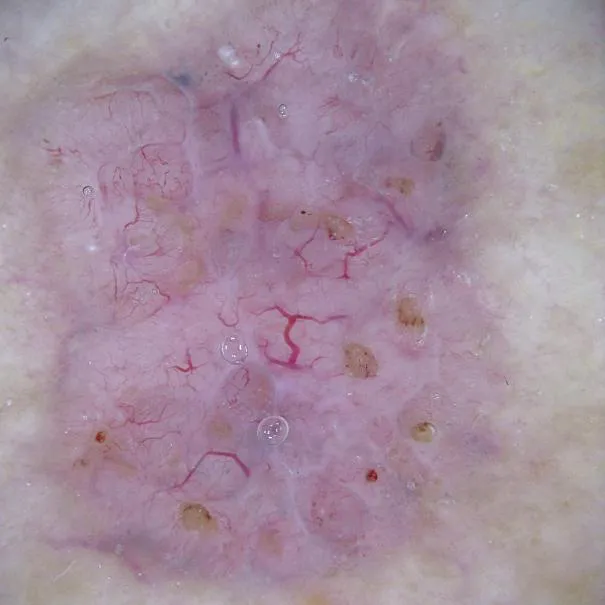 Image with non-polarized light (DE-3100)
Polarized contact Mode
In polarized mode, the instrument allows for visualization for deeper skin structures,such as blood vessels, collagen, and pigment in the dermis.
The dermoscopy does not need to be in contact with the skin or use any liquid. Theirpolarized light can help to eliminate surface reflection and allow visualization ofvascular structures.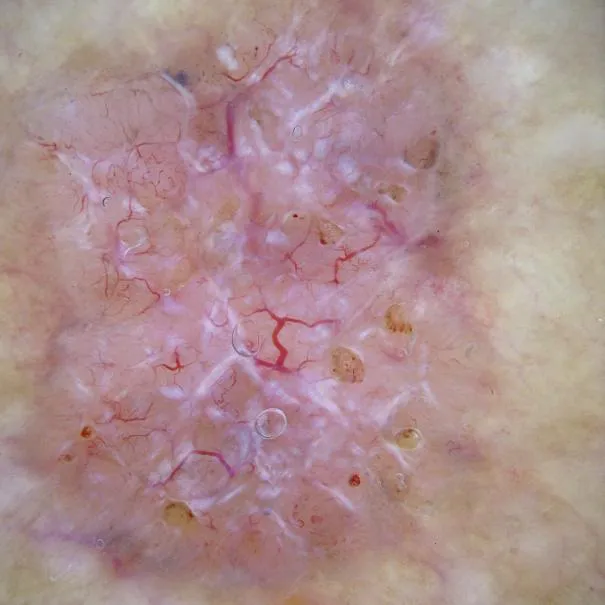 Image with polarized light (DE-3100)
Polarized non-contact Mode
The dermoscopy can also use polarized light to examine the skin without direct contact.
In polarized non-contact mode, the instrument allows for examination infected areasand lesions that are painful for the patient, or the difficult to contact pigmented lesions,such as nails and narrow areas.
The contact plate should be removed in this mode, and it does not require applying aliquid to the skin. As it doesn’t require pressure or fluid application on the skin, it canalso avoid cross-contamination and infection risk.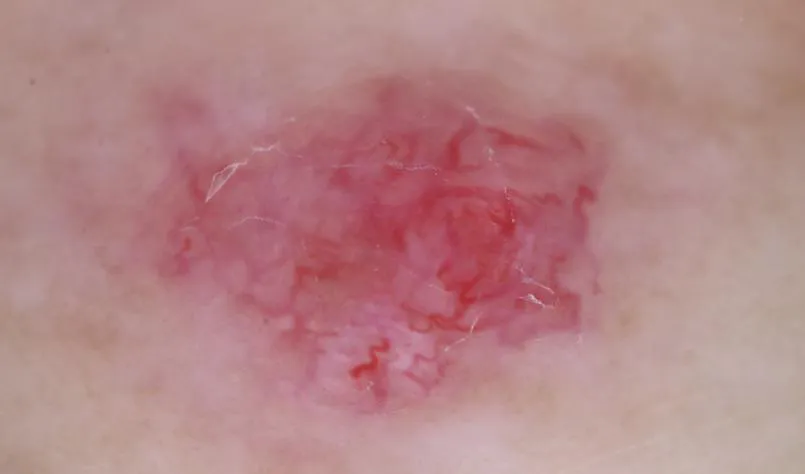 Image in polarized non-contact mode (DE-3100)
The Ultimate Guide to Polarized vs. Non-Polarized Dermoscopy: Principles, Applications, and Choosing the Right Tool
Dermoscopy, also known as dermatoscopy or epiluminescence microscopy, is an indispensable tool in modern dermatology. By providing magnified, illuminated views of skin lesions, it allows clinicians to visualize subsurface structures and patterns invisible to the naked eye. This dramatically improves the diagnostic accuracy of various skin conditions, from suspicious melanomas and basal cell carcinomas to benign seborrheic keratoses.
While the fundamental purpose of a dermatoscope remains consistent, the technology behind its illumination can vary significantly. Primarily, dermatoscopes are categorized into two main types based on their light source: non-polarized and polarized. Understanding the distinctions between these two modes is crucial for every dermatologist and healthcare professional involved in skin lesion assessment.
This comprehensive guide will delve deep into the principles, advantages, limitations, and clinical applications of both polarized and non-polarized dermoscopy, empowering you to make informed decisions and optimize your diagnostic capabilities.
What is Dermoscopy? A Brief Overview
Before diving into the specifics of polarization, let's briefly recap why dermoscopy is so vital. Traditional visual inspection of skin lesions often misses subtle yet critical features hidden beneath the skin's surface. Dermoscopy addresses this by:
- Magnification: Typically ranging from 10x to 40x, bringing microscopic details into clear view.
- Illumination: Providing a bright, clear light source to enhance visibility.
- Surface Reflection Control: This is where polarization plays a key role, allowing clinicians to peer past the stratum corneum.
The ability to visualize structures like pigment networks, globules, streaks, vascular patterns, and chrysalis structures significantly aids in differentiating benign from malignant lesions, leading to earlier detection and better patient outcomes.
Understanding Polarized Light and Non-Polarized Light in Dermoscopy
The Basics of Light and Reflection
When light hits the skin, some of it is reflected from the very surface (the stratum corneum, often called "surface glare"), and some penetrates deeper, interacting with various skin components before scattering back to the observer. To see these deeper structures clearly, the surface glare must be minimized or eliminated.
Non-Polarized Dermoscopy (Contact Mode)
Non-polarized dermoscopy utilizes standard, unpolarized light. To reduce surface reflection and allow visualization of deeper structures, this mode requires direct contact with the skin and the application of an interface medium, typically a liquid such as mineral oil, alcohol, or ultrasound gel.
- Mechanism: The liquid fills the air-skin interface, reducing the refractive index mismatch between the dermatoscope lens and the skin. This optical coupling diminishes surface glare, allowing more light to penetrate and scatter back from the epidermis and superficial dermis.
- Key Features & Observations:
- Excellent visualization of superficial skin structures, particularly those within the epidermis and dermoepidermal junction.
- Ideal for identifying structures like:
- Milia-like cysts (keratin-filled cysts)
- Comedo-like openings (follicular plugs)
- Pigment in the epidermis (e.g., melanin network, globules)
- Pseudopods and radial streaming (early melanoma features)
- Requirements: Direct skin contact and an interface fluid.
- Advantages: Historically the standard, often more affordable, excellent for epidermal details.
- Limitations: Requires liquid (can be messy, risk of cross-contamination if not sterile), direct contact can distort some lesions (especially vascular ones) or be painful for patients.
Clinical Image Example: Non-Polarized Light (DE-3100)
[Insert Placeholder for a clear image taken with non-polarized light, highlighting epidermal features like milia-like cysts or pigment network. Ensure image has descriptive alt text.]
Polarized Dermoscopy (Contact and Non-Contact Modes)
Polarized dermoscopy employs polarized light to achieve glare reduction. Light waves typically vibrate in all directions. A polarizer filter restricts these vibrations to a single plane. In polarized dermatoscopes, two polarizing filters are used:
- Incident Polarizer: Filters the light from the device before it hits the skin, allowing only light vibrating in one plane to pass.
- Analyzer Filter: Positioned in front of the observer's eye (or camera), it's oriented perpendicular to the incident polarizer.
When polarized light hits the skin's surface, the surface-reflected light largely retains its original polarization plane. However, light that penetrates deeper into the skin undergoes multiple scattering events, which depolarize it (i.e., cause it to vibrate in various planes). When this depolarized light returns to the dermatoscope, the analyzer filter blocks the surface-reflected, still-polarized light, but allows the depolarized light from deeper structures to pass through.
Polarized Contact Mode
Similar to non-polarized mode in requiring skin contact but utilizes polarized light.
- Mechanism: Uses the polarizing filters as described above to eliminate surface glare. While an interface liquid is not strictly necessary for glare reduction, some clinicians may still use it for better coupling or to reduce air bubbles.
- Key Features & Observations:
- Superior visualization of deeper skin structures within the dermis.
- Ideal for identifying:
- Vascular patterns (e.g., dotted, glomerular, linear, arborizing vessels), which are crucial for diagnosing benign vs. malignant lesions like basal cell carcinoma.
- Collagen structures (e.g., white chrysalis structures, rosettes).
- Deep pigment (e.g., blue-grey veils in melanoma).
- Follicular openings and perifollicular inflammation.
- Requirements: Direct skin contact.
- Advantages: Excellent deep structure visualization, less reliance on messy interface liquids.
- Limitations: Direct contact can still distort vascular lesions, some epidermal details might be less sharp compared to non-polarized.
Clinical Image Example: Polarized Contact Light (DE-3100)
[Insert Placeholder for a clear image taken with polarized contact light, highlighting vascular patterns or deep blue pigment. Ensure image has descriptive alt text.]
Polarized Non-Contact Mode
This is a significant advantage of polarized dermatoscopy.
- Mechanism: Leverages the same polarizing filter technology but does not require direct contact with the skin or any interface liquid. The dermatoscope is held slightly above the lesion.
- Key Features & Observations:
- Allows examination of infected or painful areas without causing discomfort.
- Facilitates assessment of lesions in difficult-to-contact areas such as nails, scalp, between toes, or narrow interdigital spaces.
- Crucial for avoiding cross-contamination and infection risk, as there is no pressure or fluid application on the skin.
- Minimizes distortion of delicate structures, especially vascular lesions, which can be compressed by contact.
- Requirements: No skin contact, no liquid.
- Advantages: Enhanced patient comfort, infection control, ideal for sensitive or inaccessible areas, preserves natural lesion morphology.
- Limitations: May be slightly less sharp for extremely superficial epidermal details compared to non-polarized contact, requires a steady hand.
Clinical Image Example: Polarized Non-Contact Mode (DE-3100)
[Insert Placeholder for a clear image taken with polarized non-contact light, perhaps showing a vascular lesion on a nail or a painful lesion. Ensure image has descriptive alt text.]
Polarized vs. Non-Polarized Dermoscopy: A Comparative Overview
To help you quickly grasp the differences and make an informed decision, here's a comparative table:
| Feature | Non-Polarized Dermoscopy | Polarized Dermoscopy |
|---|---|---|
| Light Type | Unpolarized light | Polarized light (uses cross-polarization) |
| Surface Glare Reduction | Requires interface liquid (e.g., oil, alcohol) and contact | Achieved optically (filters), no liquid needed |
| Contact Required? | Yes, always | Optional (contact & non-contact modes available) |
| Observation Depth | Superficial (epidermis, dermoepidermal junction) | Deeper (dermis, vascular structures) |
| Key Structures Visible | Milia-like cysts, comedo-like openings, epidermal pigment network | Vascular patterns, collagen (chrysalis), deep pigment, rosettes |
| Patient Comfort | May be uncomfortable with pressure/liquid | Generally better, especially in non-contact mode |
| Infection Control | Potential for cross-contamination with shared liquid/contact | Higher, especially with non-contact mode |
| Distortion of Lesions | Possible with pressure (especially vascular) | Minimized, particularly in non-contact mode |
| Best For | Epidermal features, subtle pigment changes | Vascular lesions, deep dermal pathology, sensitive areas |
Choosing the Right Dermatoscope: When to Use Which Mode
Modern dermatoscopes, like many offered by Iboolo Medical, often incorporate both polarized and non-polarized capabilities into a single device. This dual functionality is highly recommended as it provides the most comprehensive diagnostic power.
- For a quick initial scan: Start with polarized non-contact to get an overall view without patient discomfort or distortion.
- To assess vascularity or deep pigment: Switch to polarized contact (if comfortable) or continue with non-contact for clearer visualization of dermal structures.
- To meticulously examine epidermal details: Use non-polarized contact with an interface liquid for unparalleled clarity of the pigment network, milia-like cysts, or subtle surface changes.
- For lesions on nails, scalp, or intertriginous areas: The polarized non-contact mode is invaluable.
The ability to toggle between these modes allows for a holistic assessment, ensuring that no critical details, whether superficial or deep, are missed. Many experienced dermatoscopists fluidly move between modes during a single examination.
The Iboolo Medical Advantage: Versatile Dermoscopy Solutions
At Iboolo Medical, we understand the evolving needs of dermatologists. That's why many of our advanced dermoscopes, such as the DE-3100, are equipped with both polarized and non-polarized light modes. This versatility empowers clinicians to choose the optimal illumination for each specific lesion and patient scenario, enhancing diagnostic accuracy and patient care.
Our devices are designed with precision optics and user-friendly interfaces, ensuring reliable performance and comfortable operation. We are committed to providing cutting-edge medical tools that support early and accurate detection of skin diseases.
Both polarized and non-polarized dermoscopy are invaluable techniques, each offering unique insights into skin lesion morphology. While non-polarized mode excels at revealing superficial epidermal features, polarized mode provides an unhindered view of deeper dermal and vascular structures, often without the need for an interface liquid or direct contact. The ideal approach involves having access to and understanding how to effectively utilize both modes, maximizing diagnostic confidence and ultimately, improving patient outcomes.
As the field of dermatology continues to advance, the sophisticated illumination capabilities of modern dermatoscopes will remain at the forefront of non-invasive skin lesion assessment.
Frequently Asked Questions (FAQ)
Q: Do I always need to use liquid with non-polarized dermoscopy?
A: Yes, an interface liquid (like mineral oil or alcohol) is essential for non-polarized dermoscopy to reduce surface reflection and allow visualization of subsurface structures.
Q: Can I use polarized dermoscopy without skin contact?
A: Absolutely! Polarized dermoscopy offers a non-contact mode, which is one of its significant advantages. It's ideal for painful, infected, or hard-to-reach lesions, and for preventing cross-contamination.
Q: Which mode is better for viewing blood vessels?
A: Polarized dermoscopy, particularly in non-contact mode, is generally superior for visualizing vascular structures as it effectively eliminates surface glare and avoids vessel compression that can occur with direct contact.
Q: Is one type of dermoscopy sufficient?
A: While a single-mode dermatoscope can be helpful, a device offering both polarized and non-polarized capabilities provides the most comprehensive diagnostic power, allowing clinicians to assess both superficial and deep features effectively.


